

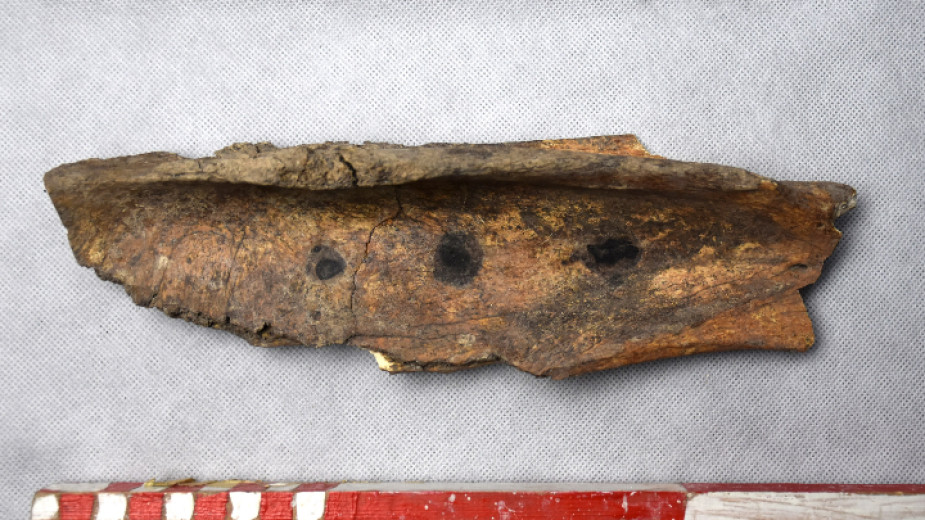
This horse shoulder blade bone (scapula) from ca. 1300 found in the Rusocastro Fortress in Southeast Bulgaria has three symmetrical, lined up burning marks, indicating a potential and completely unknown magic ritual, according to the scholars’ hypothesis. The ritual doesn’t seem likely to be connected with the Ancient Bulgars but may have to do with the Cumans or the Mongols (Tatars). Photo: Burgas Regional Museum of History
A horse scapula, i.e. a shoulder blade bone, with traces from eating and bizarre traces of burning from ca. 1300 AD, meaning it might have been used in some kind of mysterious and thus far unknown “magic” ritual, has been discovered in the Rusocastro Fortress in Southeast Bulgaria.
The horse scapula, or shoulder blade, in question is from the end of the 13th century or the beginning of the 14th century, the Regional Museum of History in the Black Sea city of Burgas has announced.
The 2020 archaeological excavations of Rusocastro – the largest medieval fortress and castle in today’s Southeast Bulgaria, a long-time stronghold of both the medieval Bulgarian Empire and the Eastern Roman (Byzantine) Empire – were completed in October.
They have led to the full unearthing of the foundations of what was a huge hexagonal central fortress tower, or a keep, among other discoveries – including a large fragment from the eastern fortress wall and a previously unknown rectangular tower on the outer fortress wall.
The Rusocastro Fortress is best known for the Battle of Rusocastro in 1332 AD. It was the last big military victory of the medieval Bulgarian Empire before it was conquered by the invading Ottoman Turks at the end of the 14th century.
In it, Tsar Ivan Alexander (r. 1331-1371) of the Second Bulgarian Empire defeated Byzantine Emperor Andronicus III Palaeologus (Andronikos III Palaiologos) (r. 1328-1341 AD).
The horse shoulder blade bone with traces from a potentially unknown medieval magic ritual has been among the numerous animal bones discovered by the Bulgarian archaeologist in the Rusocastro Fortress in the 2020 digs. However, the traces from a potential ritual have been noticed during the subsequent analysis of all bones.
The Burgas Museum of History points out that every single animal bone found in Rusocastro gets studied meticulously after the archaeological excavations.
archaeologyinbulgaria.com