

Archaeologists Have Discovered an Observation Tower and an Ancient Settlement near the City of Burgas
The archeological season in the region of Burgas started with an interesting find that sheds light on the ancient history of the region. From the end of May to the end of June, archeological excavations were carried out on the Cape Chiroza near the Kraimorie district of Burgas. The excavations were financed by the Municipality of Burgas with scientific supervisor Prof. Dr. Ivan Hristov (National History Museum) and Deputy Supervisor Dr. Milen Nikolov from RIM Burgas, the Press Center of the Municipality announced.
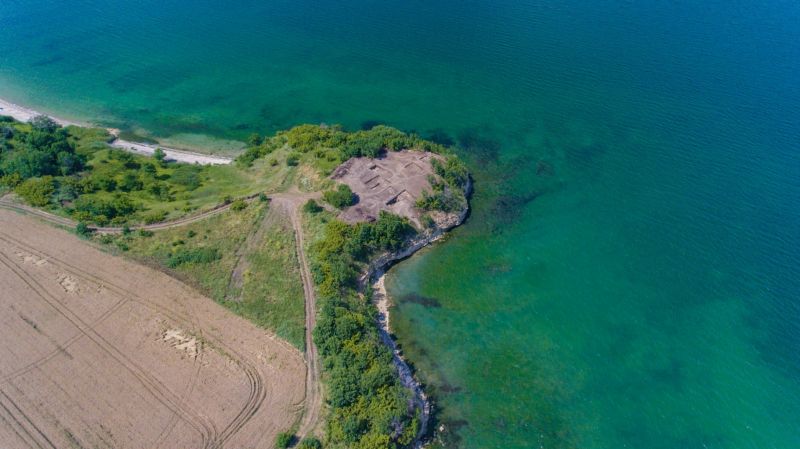
Archaeologists from the both museums have uncovered the foundations of a wall enclosing an acre of the Cape Chiroza and the foundations of a large massive two-part tower located in the highest part of the cape jutting out into the sea. In front of these structures, separate sections of a ditch up to 3 meters wide, preserved at a depth of up to 2 meters from the current terrain, have been studied. The moat probably performed defensive functions, but it is possible that its excavation also had ritual functions.
Hundreds of ceramic fragments of local Thracian pottery and imported one, mostly made in the workshops of Asia Minor around ancient Pergamum, have been found. The found coins, ornaments, amphora seals and characteristic samples of the ceramic production date the object from the end of the II-I century BC.
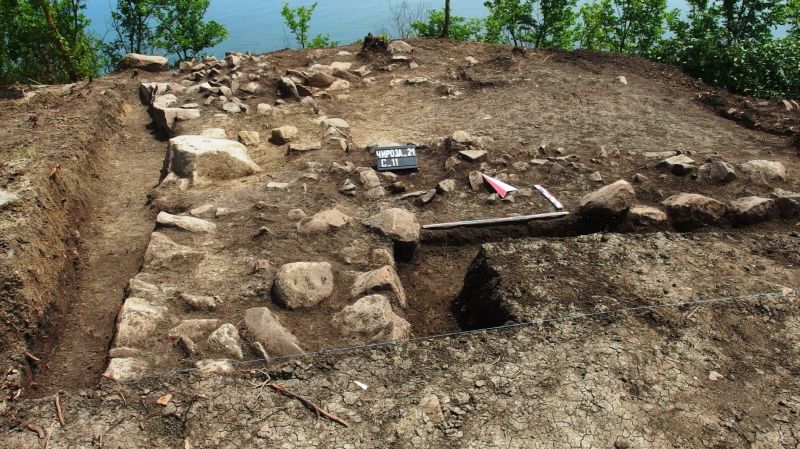
The location and massive foundations of the building, situated at the end of Cape Chiroza, are very interesting. Its foundation suggests the presence of storeys in height through stone masonry. Regardless of the data for residential use on the first floor, it is possible that this building served as a tower.
A similar tower with massive foundations has been studied on Zaychi Vrah near Kabile. Towers, similar to that of the Cape Chiroza, have been recorded in various places in the Mediterranean world. For some of them, it has been hypothesized that they have been observatories and places for transmitting signals at sea.
In this case, the Chiroza site should be considered in the context of the underwater structures found in the southeastern part of the promontory, where details of destroyed buildings, archeological material dating from the first millennium BC, as well as amphorae and building ceramics are documented underwater from the Roman and late antiquity.
The conducted excavations on Cape Chiroza fill a white spot in the history of the coastal settlement system of the Western Pontus between the Atia Peninsula and the region of today’s Burgas.
As a plan of operation, the site finds parallels with the fortified sites on the western Bulgarian Black Sea coast: Palyura locality near the village of Emona, Cantona on the northern shore of Mandra Lake; Farmakida locality near the town of Primorsko; Brodilovo village, Tsarevo Municipality; Sinemorets village, Tsarevo Municipality; Ravadinovo village, Sozopol Municipality and Izvor village, Burgas Municipality.
The research of Prof. Hristov and his colleagues from the Burgas Museum continues underwater in the Chengene Sckelle Bay.