

A 2,500-year-old Thracian Pit Sanctuary Was Discovered in the Burgas Complex Izgrev
A newly discovered archeological site was shown today during a press conference in the city of Burgas’s complex Izgrev. It is a Thracian pit sanctuary from the 5th to the 4th century BC.
The rescue archeological excavations at the site started on May 26, 2020 in the area of a construction site for the construction of a future residential building with an area of 877 m2 on N. Petkov Blvd. The terrain is 7-8 m above sea level. It is interrupted by modern drainage communication, which to some extent complicates the study.
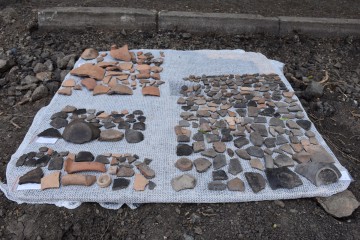
At present, 14 ritual pits are under investigation and at least ten more are located. At the level of initial registration they have dimensions from 1.10 to 2.50 m. In depth they expand – the so-called. “bell-shaped” or “pear-shaped” pits. Their depth from the level of detection to the bottom reaches 0.80-0.90 m. The found materials are: fragments of ceramic vessels, made by hand and on a potter’s wheel – cups, bowls and amphorae. There are human and animal bones in the pits, as well as coals. No metal finds have been found at this stage. For the pits there are indications that they are accumulated on levels with burnt coating.
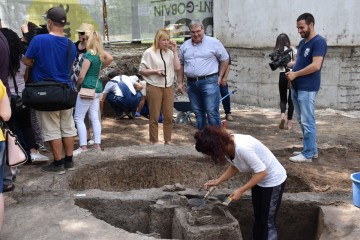
“Almost 80% of the pottery found at the site is handmade and is certainly the work of local inhabitants – Thracian tribal communities. At this stage, the dating of the discovered materials indicates V-IV century BC. Probably the fragments of amphorae will expand the chronology to the 3rd century BC “, commented the scientific director of the archeological excavations, assistant Miroslav Klasnakov from the Regional Historical Museum – Burgas. He also said that the history of the Burgas complex is quite interesting, and the archeology – rich and diverse.
“Many single and collective archeological finds are known from here. As early as 1925, the prominent Bulgarian prehistorian V. Mikov published materials from the late Neolithic (the second half of the 6th millennium BC), discovered during the so-called” Sweet channel “near the village of Atanasovo. These findings are included in the capital work of the American anthropologist from Harvard University J. Gaul, published in 1948 in the United States,” explained Klasnakov.
The archaeologist informed that in RIM-Burgas are stored fragments of ceramic vessels, various ceramic and stone finds, an amphora, a fragment of a marble statuette found on the territory of the complex. There is also data on stock, coins, etc. A collective coin find of Central European and Turkish coins dating from the 15th-18th centuries has been published.
The inscription of Apollonius, son of Eptaykent (later adopted by Gaius Julius Apollonius), strategist of the Thracian king Remetalk II, dating from the beginning of the 1st century, is extremely important. All these materials cover a large chronological section from late prehistory to the Renaissance. “, Klasnakov added.
The press conference was attended by the Deputy Mayor of Burgas Diana Savateva, the press secretary of the OD of the Ministry of Interior – Burgas Tsvetelina Randeva and Georgi Kuzmanov – contractor of the construction site, on the territory of which the Thracian ritual complex is located.
Certificates of appreciation for civil valor were presented on behalf of the OD of the Ministry of Interior and by RIM – Burgas to the journalist Galina Teneva, who signaled the presence of the remains of ceramic vessels at the site of the archaeological site.
ПОДКРЕПЕТЕ НИ
Ако желаете да подкрепите нашите усилия и работа, може да го направите като дарите средства, доброволен труд, материали за работа или експертна подкрепа!